
Looking to book a warehouse line marking service in Newcastle or the Central Coast? This guide covers the rules and best practices. If you’re ready to get your floor marked by professionals, visit our Warehouse Line Marking Services page for quotes, service areas, and bookings.
A busy warehouse never stops moving. Forklifts shift heavy pallets, delivery trucks reverse into loading docks, and pickers walk between racks all day. Without visible boundaries and consistent rules, that constant activity becomes a serious safety problem — and a serious compliance one.
Warehouse safety line marking is the standard control measure for managing this. Painted boundaries and colour-coded zones give your team a visual language they can read instantly: where to walk, where to stop, where to keep clear. Done properly, safety line marking reduces forklift incidents, satisfies SafeWork inspectors, and keeps your business defensible if something does go wrong.
This guide covers the Australian Standards that apply, the colour codes that are accepted across industry, the types of safety markings every warehouse should have, common compliance mistakes to avoid, and a practical checklist you can use to audit your own floor. It’s written for operations managers, WHS officers, and business owners who need to understand the rules — not just install them.
What Is Warehouse Safety Line Marking?
Warehouse safety line marking is the process of applying industrial paint or durable tape to a facility floor to guide traffic and highlight specific zones. Think of it as a road map for your indoor operations. Just as highway lanes keep cars from crashing into one another, floor lines keep pedestrians separated from heavy machinery.
For example, a solid yellow line painted three feet away from a storage rack creates a dedicated walking path. Workers know they must stay inside that path, and forklift operators know they must keep their vehicles outside of it. This simple visual cue removes the guesswork from daily operations and drastically lowers the risk of collisions.
Why Safety Line Marking Is Critical in Warehouses
The main goal of industrial line marking is accident prevention. Forklifts are heavy, difficult to stop quickly, and often carry loads that block the driver’s vision. When you separate pedestrians and vehicles with clear floor markings, you protect your staff from life-threatening injuries.
These markings also improve daily efficiency. When truck drivers know exactly where to park and workers know exactly where to place outgoing pallets, you eliminate confusion. Tasks are completed faster because the designated zones are obvious.
Finally, maintaining clear lines ensures your business remains compliant with national safety laws. Failing to protect your workers can result in severe legal penalties, business closures, and lasting damage to your company’s reputation.
Compliance Guidelines for Warehouse Safety Line Marking
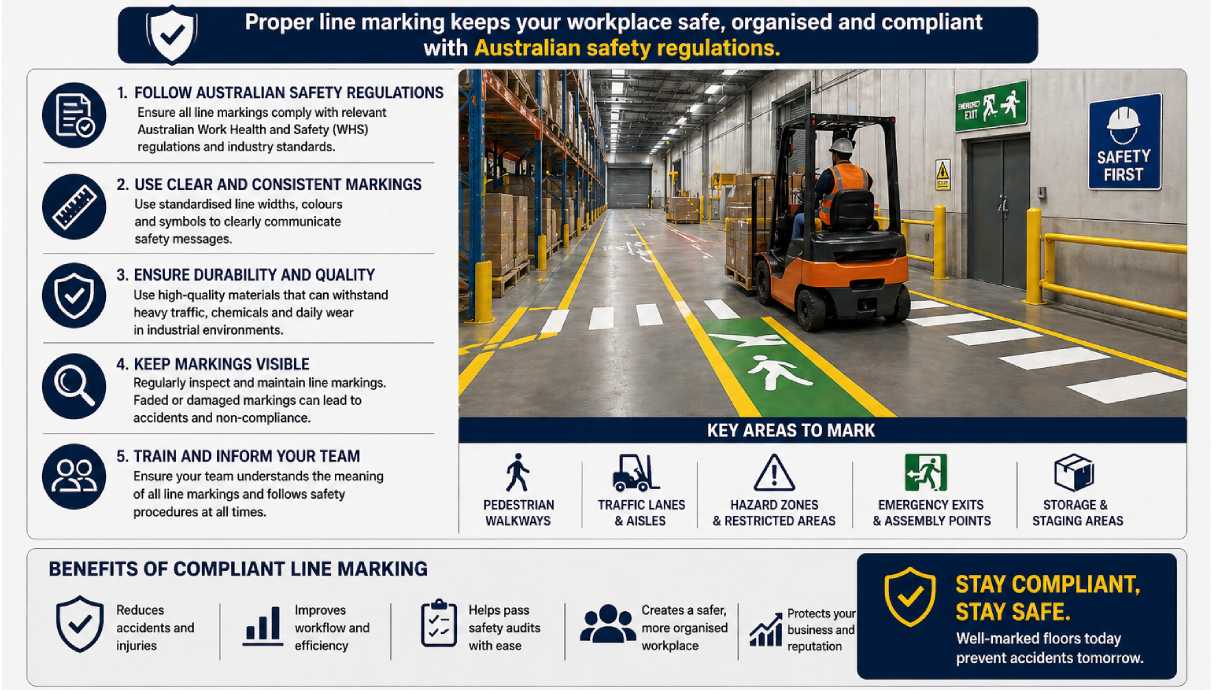
Meeting legal safety requirements requires planning and an understanding of national guidelines. In Australia, business owners have a legal duty to provide a safe working environment, and traffic management is a major part of that responsibility.
Understanding Local Safety Regulations
Safe Work Australia provides clear directions for managing traffic in warehouses. The most effective way to protect people is to separate them completely from mobile plant equipment like forklifts. Because physical barriers are not always possible, the guidelines strongly recommend using line markings to indicate traffic flow. You must clearly mark pedestrian exclusion zones, driver safety zones, and load-shifting parking areas. Visiting drivers and new staff must be able to navigate the space safely based on your floor markings alone.
Key Industrial Safety Standards for Line Marking
The AS 1319-1994 standard regulates safety signs and background color markings in Australian occupational environments. This standard ensures that colors are used consistently across different workplaces. When workers move from one factory to another, they should instantly recognize that red means danger and yellow means caution. Applying these specific industrial safety standards to your floor markings ensures your safety warnings are universally understood.
Common Compliance Mistakes to Avoid
Many facilities fail compliance audits because of simple oversights. A frequent mistake is letting lines fade over time. If a forklift driver cannot clearly see the edge of a pedestrian walkway, the line is useless. Another common error is failing to update the floor plan after changing the warehouse layout. If you move your storage racks, you must update your factory line marking to match the new traffic flow.
Types of Warehouse Safety and Hazard Line Markings
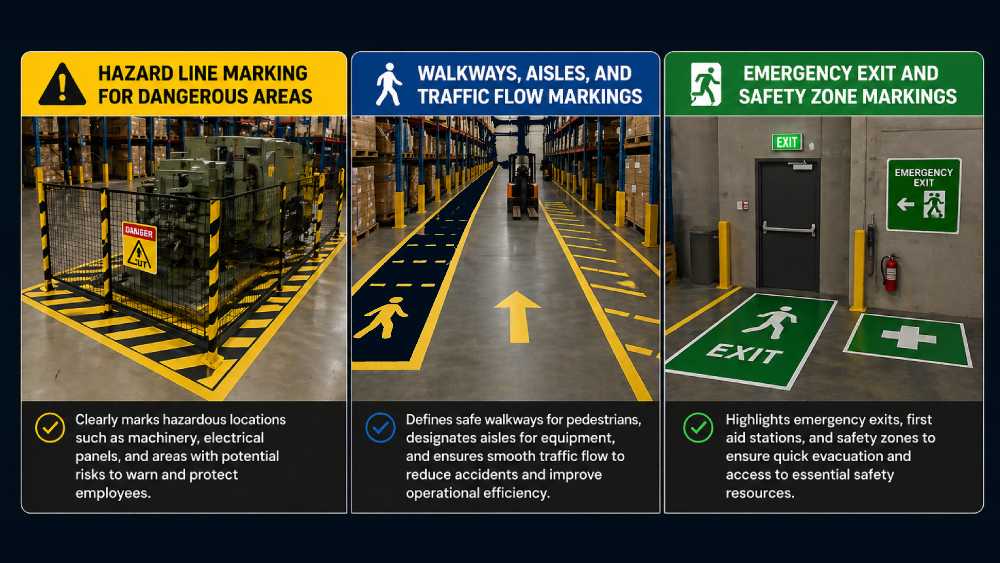
Different areas of your facility require different types of visual cues. Understanding these categories helps you build a safe and organized workspace.
Hazard Line Marking for Dangerous Areas
Hazard line marking warns staff to stay away from specific dangers. You might use these markings around electrical panels, chemical storage areas, or open ledges. Often, hazard zones use diagonally striped patterns, like yellow and black, to signal that extra caution is required before entering the space.
Walkways, Aisles, and Traffic Flow Markings
These are the most common markings in any warehouse. Solid lines outline pedestrian paths, ensuring staff can walk to the breakroom, bathrooms, or exits without crossing into forklift territory. You can also paint directional arrows on the floor to create one-way aisles, which prevents forklifts from trying to pass each other in tight spaces.
Emergency Exit and Safety Zone Markings
During a fire or power outage, staff need to evacuate quickly. Floor markings leading to emergency exits must remain clear of pallets and boxes at all times. Similarly, safety zones around first aid stations and fire extinguishers must be marked so they are never blocked by stored goods.
Warehouse Safety Line Marking Color Codes and Their Meanings
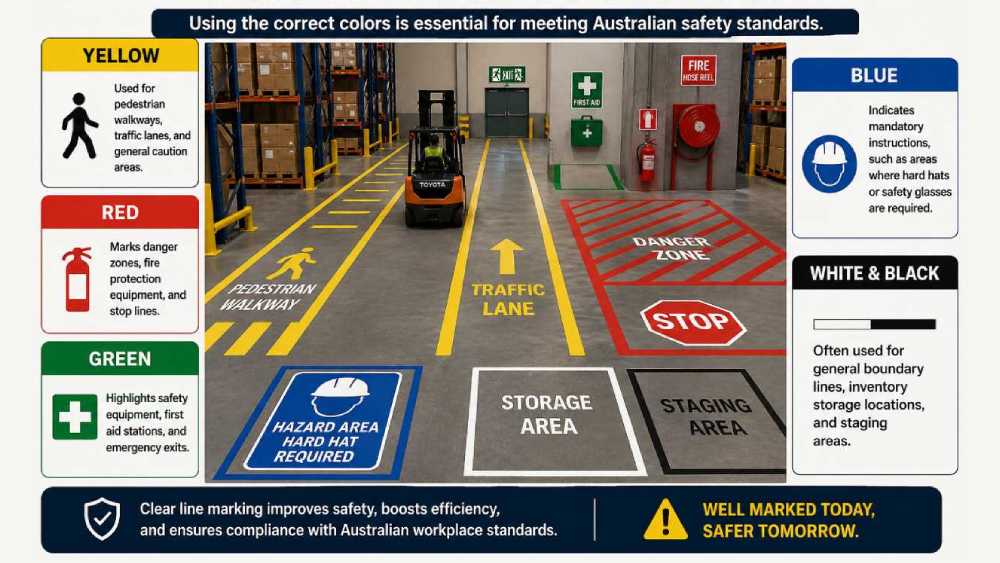
Using the correct colors is essential for meeting Australian safety standards. Here are the generally accepted color codes for warehouse environments:
- Yellow: Used for pedestrian walkways, traffic lanes, and general caution areas.
- Red: Marks danger zones, fire protection equipment, and stop lines.
- Green: Highlights safety equipment, first aid stations, and emergency exits.
- Blue: Indicates mandatory instructions, such as areas where hard hats or safety glasses are required.
- White and Black: Often used for general boundary lines, inventory storage locations, and staging areas.
Warehouse Safety Line Marking Compliance Checklist
Use this simple checklist to review your current floor markings and identify areas that need attention:
- Are all pedestrian walkways clearly marked and separated from forklift routes?
- Can you clearly see the lines from a distance, or are they faded and peeling?
- Are emergency exits and fire extinguishers highlighted with the correct colors?
- Do the floor lines match the current layout of your racks and machinery?
- Are hazard zones clearly marked with high-visibility stripes?
- Is the area around electrical panels completely free of stored items and marked with boundary lines?
Best Practices for Long-Lasting Safety Line Marking
The durability of your lines depends heavily on how they are applied. Paint will not stick to a dirty or oily floor. Before applying any markings, the concrete must be thoroughly cleaned, swept, and often mechanically prepared.
Choosing the right material is also important. While floor tape is an option for temporary changes, it tends to peel under heavy forklift traffic. For permanent results, industrial epoxy paint or thermoplastic materials offer the best durability. High-traffic areas, like loading docks, require heavy-duty paint that can withstand the friction of spinning tires and heavy pallets.
When to Hire a Warehouse Line Marking Professional
Painting an entire facility requires significant time, specialized equipment, and a deep understanding of safety laws. Attempting a do-it-yourself job often leads to crooked lines, peeling paint, and compliance failures.
Hiring warehouse line marking services ensures the job is done right the first time. Professionals have the surface preparation equipment needed to make the paint bond correctly to the concrete. They also work quickly, minimizing downtime so your business can get back to normal operations. Most importantly, experienced contractors understand the legal safety standards, giving you peace of mind that your facility is fully compliant and your workers are protected.