
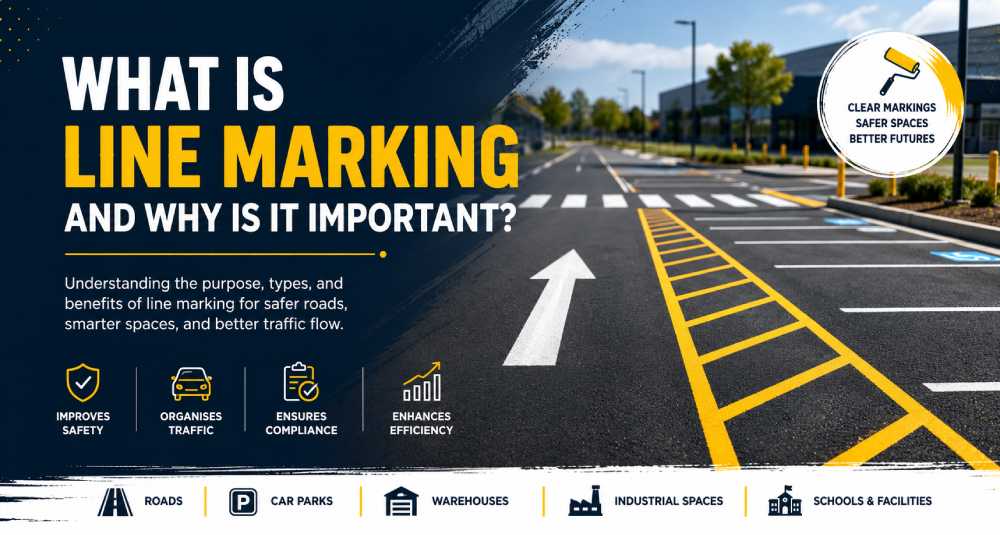
Quick answer: Line marking refers to the application of painted or thermoplastic lines, symbols, and signs on surfaces such as roads, car parks, warehouses, and sports courts. It plays a critical role in guiding movement, improving safety, and ensuring compliance with Australian standards across both public and commercial environments.
Every road you drive on, every car park you navigate, every warehouse floor you walk across. Line marking is working silently in the background. It organises space, prevents accidents, and keeps people moving safely. Yet despite its importance, it’s often one of the last things businesses think about until something goes wrong.
This guide covers everything you need to know about line marking in Australia: what it is, where it’s used, which materials work best, and why getting it right matters.
What Is Line Marking?
Line marking is the process of applying durable lines, symbols, and patterns to surfaces such as asphalt, concrete, and indoor flooring. These markings communicate critical information. Where to park, which direction to travel, where hazards exist. Without a word being spoken.
At its core, line marking is about clarity and control. It tells people where to go, what to avoid, and how to share a space safely.
Why Is Line Marking Important?
Road Safety
Clear road markings reduce the risk of collisions by defining lanes, pedestrian crossings, stop zones, and merge points. Faded or absent markings force drivers to make judgement calls. And that’s where accidents happen.
Traffic Flow
Well-designed markings keep vehicles and pedestrians moving predictably. In car parks, this means fewer bottlenecks. On roads, it means smoother intersections and fewer near-misses.
Legal Compliance
Businesses and councils have legal obligations to maintain compliant line marking. Failure to meet Australian standards can result in fines, liability claims, and workplace safety breaches.
Improved Visibility
Reflective and high-contrast markings remain visible at night, in wet conditions, and during low-light hours. Conditions where visibility is most critical and most often overlooked.
Where Is Line Marking Used?
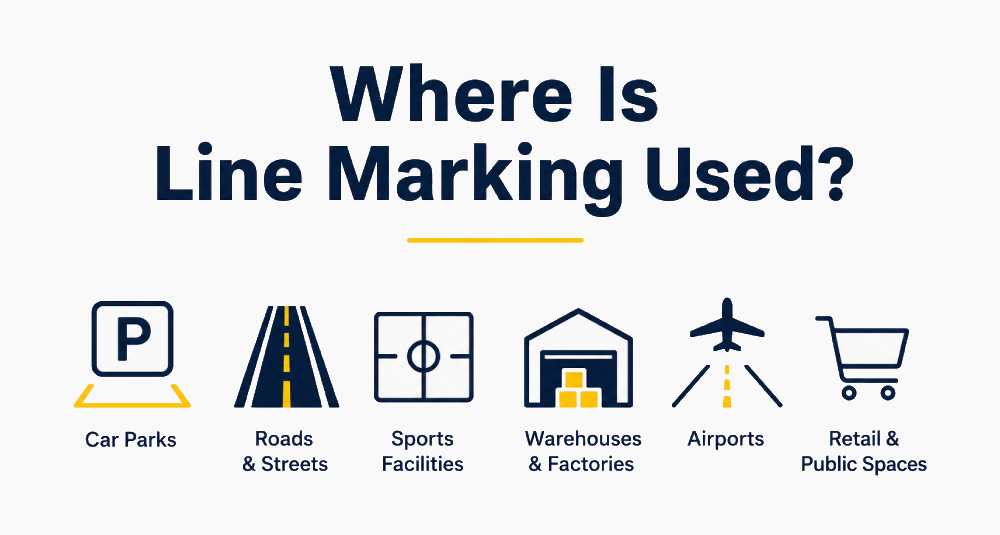
Line marking appears across a wide range of environments, each with its own requirements.
Roads
Lane lines, centre lines, stop bars, give way lines, and pedestrian crossings all fall under road line marking, governed by Australian Standard AS 1742.
Car Parks
Parking bays, directional arrows, disabled spaces, loading zones, and pedestrian walkways help maximise space and prevent confusion.
Warehouses
Forklift paths, pedestrian walkways, hazard zones, and storage areas are defined through colour-coded floor markings that support safe, efficient operations.
Factories
Factory floor marking identifies machinery boundaries, emergency exits, and safety zones. Reducing workplace incidents and supporting WHS compliance.
Schools
Schools use line marking for pedestrian safety zones, car drop-off areas, and playground activities, keeping students and staff safe.
Shopping Centres
Clear car park markings, accessible parking spaces, and pedestrian crossings are essential for managing high volumes of traffic safely.
Sports Courts
Basketball, tennis, and netball courts require precise markings that conform to official dimensions, ensuring fair play and clear visibility.
Airports
Airports rely on highly specialised markings for aircraft taxiways, tarmac zones, and ground vehicle pathways, where accuracy is non-negotiable.
What Are the Different Types of Line Marking?
Longitudinal Lines
These run parallel to the direction of travel. Think centre lines, lane lines, and edge lines. They are among the most common road markings and are essential for lane discipline.
Transverse Lines
Transverse lines run perpendicular to traffic flow. Stop lines, give way lines, and pedestrian crossings all fall into this category.
Arrows
Directional arrows guide drivers through intersections, car parks, and roundabouts, communicating permitted directions of travel.
Symbols
Symbols such as disabled parking icons, bicycle lane logos, and speed limit text communicate specific rules without relying solely on signage.
Parking Bays
These run parallel to the direction of travel. Think centre lines, lane lines, and edge lines. They are among the most common road markings and are essential for lane discipline.
Hatched Areas
Hatched or diagonal markings indicate areas that must not be entered or used for parking. Such as clearways, safety zones, and no-stopping areas.
What Materials Are Used in Line Marking?
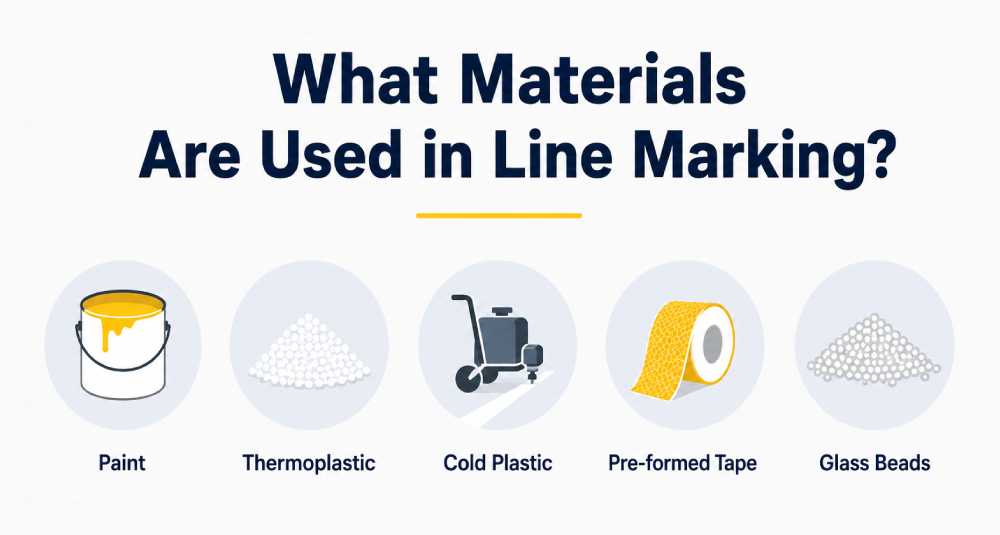
Material selection has a direct impact on durability, visibility, and long-term cost. The right choice depends on the environment, traffic volume, and surface type.
Waterborne Paint
The most widely used material in Australia. Waterborne paint is cost-effective, quick to apply, eco-friendly, and compatible with most surfaces. It typically lasts 6–18 months, making it well-suited to lower-traffic areas or sites that require regular updates.
Thermoplastic
Thermoplastic is applied in a molten state and solidifies quickly on contact with the surface, creating a thick, highly durable marking. It lasts 3–5 years or more, making it the preferred choice for roads and high-traffic areas. The higher upfront cost is offset by reduced maintenance needs over time.
Epoxy
Epoxy coatings are common in warehouses and industrial settings. They bond strongly to concrete, resist chemicals and heavy wear, and deliver a clean, professional finish that holds up under forklift traffic and ongoing foot traffic.
MMA (Methyl Methacrylate)
MMA is considered one of the hardest-wearing marking materials available. It cures rapidly at ambient temperatures, bonds to both concrete and asphalt, and performs well in high-stress environments. MMA offers superior resistance to abrasion, UV exposure, and adverse weather conditions.
Cold Plastic (CAP)
Cold Applied Plastic (CAP) is a two-component system. Typically a resin mixed with a hardener. That cures chemically without heat. According to Pacific Markings, CAP can last 5–10 years in typical commercial or road environments, making it 3–5 times longer-lasting than standard paint. CAP is particularly effective on concrete surfaces and is well suited to busy car parks, pedestrian crossings, and warehouse floors with heavy forklift traffic.
What Are the Australian Line Marking Standards?
AS 1742
Australian Standard AS 1742.2:2009 defines road line marking types, widths, and pavement marking requirements for Australian public roads. It is the primary reference for road authorities, contractors, and councils when planning or inspecting road markings. Austroads. A group representing Australian and New Zealand transport agencies. Has also developed a Harmonisation of Pavement Markings specification to improve consistency between jurisdictions.
Local Council Requirements
Beyond AS 1742, local councils impose their own requirements for car parks, pedestrian zones, and public spaces. These vary between states and territories and must be verified before any line marking project begins.
Workplace Safety Regulations
Under Work Health and Safety (WHS) legislation, businesses are required to maintain safe work environments. Which includes compliant floor marking in warehouses, factories, and industrial facilities. Colour-coded systems (such as yellow for pathways, red for hazard zones, and green for safe areas or exits) are commonly mandated under these frameworks.
What Are the Benefits of Professional Line Marking?
Professional line marking contractors bring precision, compliance knowledge, and quality materials to every project. Key benefits include:
- Accuracy: Advanced equipment ensures crisp, consistent lines that meet regulatory specifications.
- Compliance: Experienced contractors understand AS 1742, WHS requirements, and local council standards, removing the compliance burden from the client.
- Durability: Professional-grade materials and correct surface preparation extend the life of markings significantly.
- Efficiency: Projects are completed with minimal disruption to daily operations.
- Long-term savings: Quality markings reduce the frequency of repainting and the risk of costly compliance penalties.
How Long Does Line Marking Last?
Lifespan varies based on material, surface type, traffic volume, and weather conditions. As a general guide:
Material | Typical Lifespan |
|---|---|
Waterborne Paint | 6–18 months |
Thermoplastic | 3–5 years |
Epoxy | Several years (indoors) |
Cold Plastic (CAP) | 5–10 years |
In Australian conditions, UV exposure and heat accelerate fading. Particularly for painted markings. High-traffic sites such as shopping centre car parks will experience faster wear and require more frequent inspections.
How Is Line Marking Applied?
The application process varies depending on the material and environment:
- Spray application is used for large-scale projects, delivering fast and uniform results across wide areas using precision line marking equipment.
- Stencil application is used for symbols, arrows, logos, and custom designs that require precise shapes.
- Extrusion is the method most commonly used with thermoplastic, ensuring consistent thickness for high-traffic road markings.
Proper surface preparation is essential regardless of method. The surface must be clean, dry, and free from oil, grease, or debris before application. For worn or contaminated surfaces, shot blasting or grinding may be required to ensure strong adhesion.
Why Choose Professional Line Marking Services?
Cutting corners on line marking is a risk most businesses cannot afford. Non-compliant markings can expose property owners to fines, legal liability, and most critically. Serious safety incidents.
A qualified line marking contractor will assess your site, recommend the right materials for your conditions, and deliver results that meet Australian standards and stand the test of time. Whether you manage a warehouse, a retail car park, a school, or a road network, professional line marking is a straightforward investment in safety, compliance, and operational efficiency.
Frequently Asked Questions
Line marking is used to guide traffic, designate parking spaces, identify hazards, define work zones, and communicate safety information across roads, car parks, warehouses, sports courts, and other commercial or public spaces.
Australian Standard AS 1742.2:2009 governs road line marking in Australia, covering line types, widths, colours, and placement requirements. Austroads also publishes supplementary guidance to harmonise practices across states and territories.
Lifespan depends on the material used. Waterborne paint typically lasts 6–18 months, thermoplastic lasts 3–5 years, and cold applied plastic (CAP) can last 5–10 years. UV exposure and heavy traffic accelerate wear, particularly in outdoor environments.
Cold Applied Plastic (CAP) and MMA are among the most durable options available, lasting 3–5 times longer than standard paint in high-traffic conditions. Thermoplastic is also highly durable and widely used for road applications.
In most cases, yes. Businesses operating car parks, warehouses, factories, or other commercial facilities are required to maintain compliant line marking under WHS regulations and local council requirements. Accessible parking spaces also carry specific compliance obligations.
Paint markings should be inspected regularly and repainted every 6–18 months depending on traffic levels and weather exposure. Thermoplastic and CAP markings require less frequent attention but should still be inspected annually for fading or damage.
Yes. Old or incorrect markings can be removed using methods such as shot blasting, water blasting, or grinding. The appropriate removal method depends on the surface type and the material used for the existing markings.